

YSS Assessment Policy
YSS ASSESSMENT POLICY
GUIDELINES FOR PRACTICE
The YSS Assessment Policy guides the design of the curriculum and assessment practices in the school. The policy creates a reference point for all members of the YSS learning community to allow our students to achieve the Desired Outcomes of Yishunite.
The school takes reference from Singapore Teachers’ Practice (STP) and YSS Curriculum Framework which emphasise the importance of quality T&L in developing a Quality Mind and a Caring Heart in each Yishunite. Every YSS teacher strives to become competent in reflecting and applying all the components of the teaching processes.
Principles of Assessment
The three core principles that define our approach to assessment are:
-
Assessment is integral to the learning process
-
Assessment begins with clarity of purpose
-
Assessment should gather information to inform future practices
Assessment is closely aligned with curricular objective, content and pedagogy of the teaching and learning. Assessment allows for the collection of information about the quality and extent of student learning and development. The aims of assessment include:
-
improving student learning through the provision of relevant and timely feedback
-
providing information on the effectiveness of teaching processes
-
improving the design and delivery of programmes
-
certifying student achievement with respect to grade-level learning outcomes for placement at subsequent levels
-
supporting the development of competencies that students would need in their daily lives and the future workplace.
Modes of Assessment
Learner-centred and balanced assessment is holistic and aims to assess and develop the whole child. Assessment is progressively sequenced to support the developmental aims of the curriculum. There are clear rubrics and success criteria for each assessment, whether formative or summative. Although Weighted Assessment (WA) is done summatively, the information gathered is used in a formative manner to progressively develop the students’ content knowledge and skills. Students may also be assessed through a variety of alternative assessment modes and E-assessments to allow them to demonstrate learning in a variety of ways.
Assessment Feedback & Reports
Feedback is an essential part of the improvement process in assessment. Teachers are encouraged to offer timely feedback to students in a constructive and meaningful way that would enhance motivation and individual target setting. Teachers also share the criteria for awarding marks with students to help them understand the expected standards. Feedback is valuable when it is received, understood, and acted on. Thus, written assignments and weighted assessments must be returned to students within two weeks of submission and students are expected to work on the feedback provided by the teachers to develop their learning. Results for weighted assessments are reported termly.
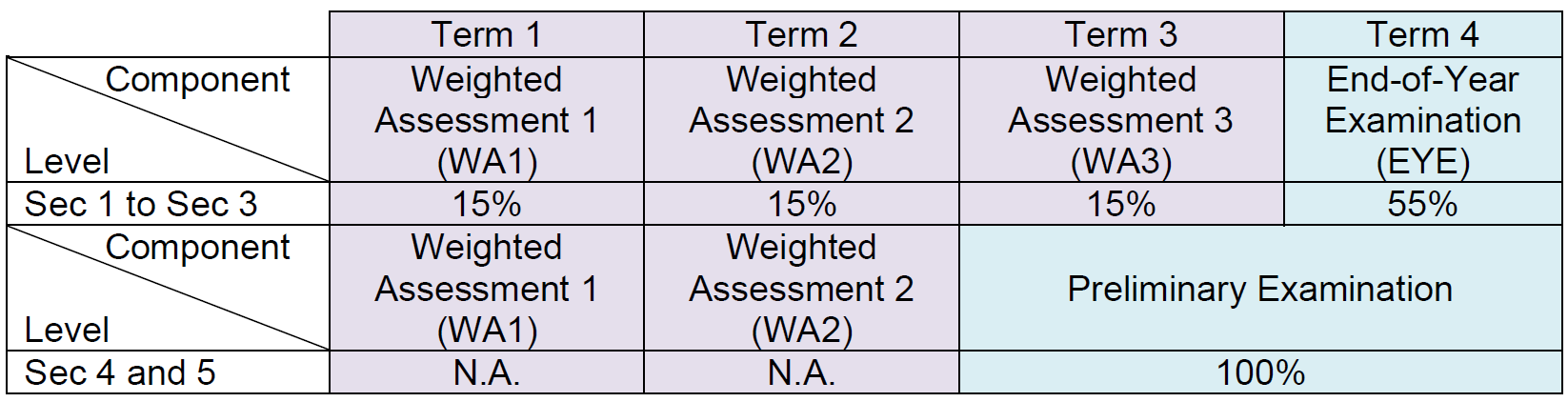
Assessment Weighting
For Secondary 1 to 3, there will be no more than one weighted assessment per subject, from Term 1 to 3.
For Secondary 4 and 5, there will be no more than one weighted assessment per subject, in Term 1 and 2.
Approved Access Arrangements
Students will be given additional 5 minutes for WA.
For preliminary examinations, students will be given access arrangements based on SEAB’s instructions. For EYE, students will be given full access arrangements based on past SEAB’s instructions for similar cases.
Absence from Graded Assessment
A student who is absent for a paper due to illness must produce a medical certificate to cover his/her absence. The medical report / statement must clearly state the doctor's diagnosis and certify that the student was unfit to take the test. A medical certificate without the doctor's diagnosis is not a valid supporting document. Students without a medical certificate will be given a zero mark for the paper that they miss. Medical certificates issued by Traditional Chinese Medicine (TCM) practitioners and letters from parents will not be accepted.
For other cases of absence from WA:
|
Status |
Outcome |
Remarks |
|---|---|---|
|
Students who miss WA due to (i) SYF or (ii) NSG or any external competition. |
Students will sit for their WA on either the same week or within the next week. |
WA marks will be taken into account. |
|
Students who miss WA due to medical reason (must submit valid MC). |
Students will take the WA as practice. |
WA marks will be reflected as ‘MC’. |
|
Students who miss WA without any valid reason. |
Students will take the WA as practice. |
WA marks will be reflected as ‘AB’. |
Academic Conduct, Integrity and Responsibility
All students are responsible for upholding the highest standards of academic conduct and integrity in all academic undertakings. Any act of academic dishonesty, including cheating and plagiarism, will be subject to stern disciplinary action.
Homework Time Guidelines
Taking the Sleep Health: Homework Guideline Review into consideration, the recommended homework time per subject are:
|
Level |
Weekly |
Mar/Sep Holidays |
Jun/Nov/Dec Holidays |
|---|---|---|---|
|
Sec 1 to Sec 2 |
1.5 h |
Not encouraged |
2.0 h per subject |
|
Sec 3 to Sec 5 |
2.0 h |
1.0 h per subject |
2.0 h per subject |
* Homework is given in every subject at least once a week. The amount of time a student spends on assigned homework depends on factors such as the student’s needs and learning ability.
The revised daily screen use limit for homework should not exceed two hours.
Submission of Work
Students are expected to submit their homework by the stipulated deadline set. Any request for extension should be made before the assignment due date. Students are responsible for making up missed or incomplete work. Those who did not submit their work without a valid reason (e.g. illness) will be dealt accordingly by respective IP Heads and Year Heads. Students who repeatedly do not submit homework and have no valid reasons, will have to serve Restorative Reflection Period (R2P). The number of days they serve will depend on the frequency and severity of the non-submission. Parents/guardian will also be informed if their child/ward frequently do not submit their assignments.
File Check
Students are required to submit their files and materials, across all subjects, for checking. Department Heads and Subject Teachers will inform the students on the schedule and procedure for submission of the books and files.
The Role of the Teacher
Assessment is an important part of the YSS Curriculum as it is a powerful tool to guide and support students’ learning. Assessment is For learning (formative), Of learning (summative) and As Learning (self-directed and reflective). In planning learning experiences, teachers will also plan how they will monitor students’ progress, provide feedback and facilitate the attainment of essential learning outcomes. Teachers will adopt a learner-centric approach to assessment by:
-
providing a range of opportunities for students to demonstrate learning and understanding;
-
gathering and recording evidence of students’ demonstrations of learning;
-
making judgements about students’ level of attainment of learning outcomes;
-
guiding the planning of teaching and learning programmes;
-
providing students with clear criteria for success; and
-
engaging students in self-reflection, to enable them to keep track of and share their learning.
Support from Parents/Guardian
The school values parents and guardian support in monitoring students’ learning and progress at home. The assessment plans for the year (WA components and respective weightings) are found in the online student handbook and the test/major assignment schedule is available in the school website.
Advice to Students
-
Communicate with the teacher if there are any questions or concerns about the purpose or expectations of assignments/homework.
-
Use organisational tools such as personal calendars, homework calendars, class websites or chat applications to record assignment/tasks.
-
Establish a place with no distractions for completing homework.
-
Work within structured chunks of time with short breaks in between.
-
Schedule and limit a set time for social networking AFTER homework is completed. Minimise or set limits on possible distractions: TV, gaming, texting etc.
-
Check and ensure that homework is completed as instructed and submitted by the stipulated deadline.
-
Set clear learning targets for yourselves.
-
Take action to improve learning based on assessment information, which includes feedback given by teachers.
Yishun Secondary School
Published in January 2026